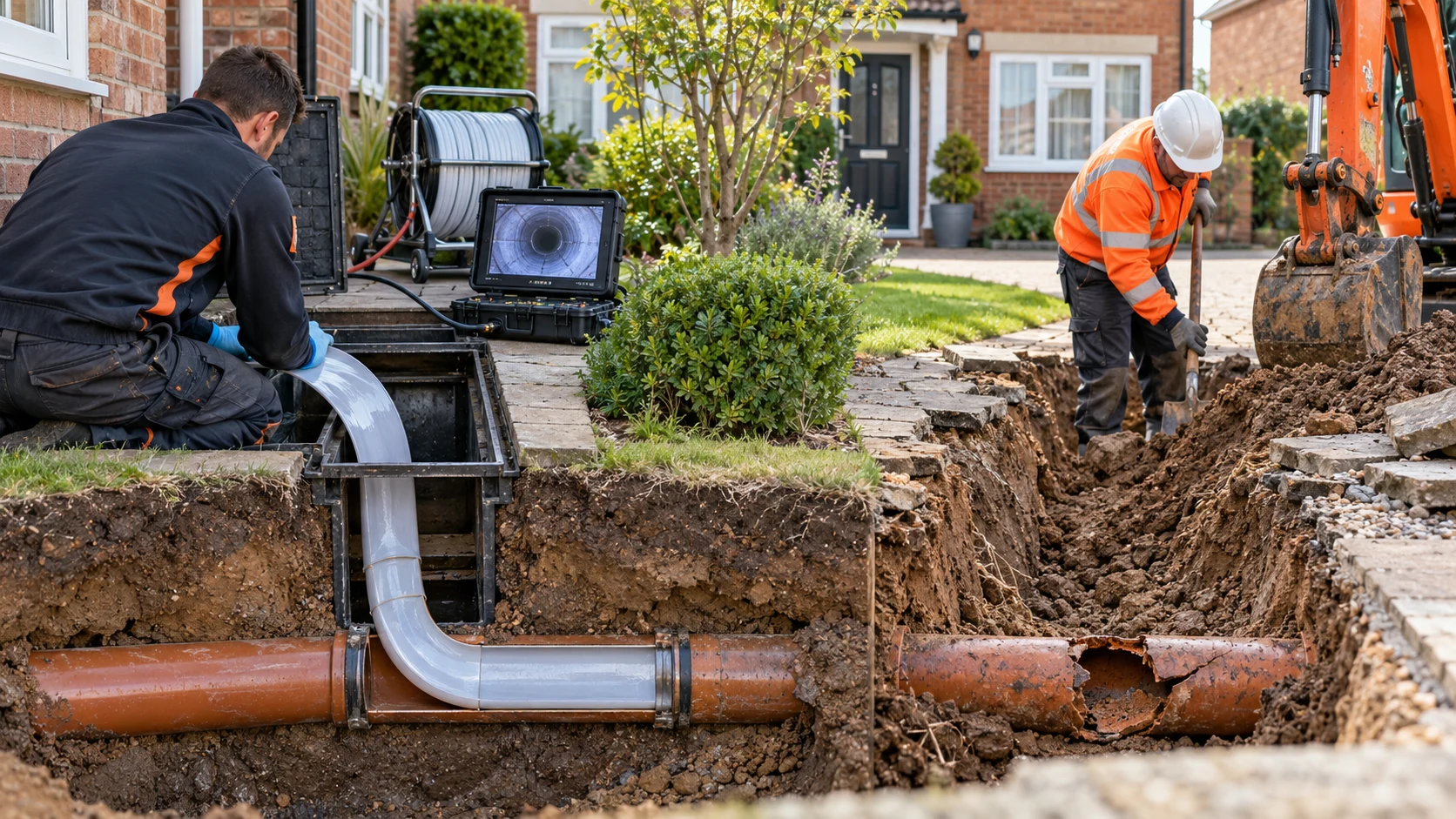
Illustrative comparison showing that some damaged drains can be repaired without full excavation.
The short answer
A damaged drain does not always require a long trench. Localised patch repairs or suitable lining methods may work for some accessible defects, provided the pipe retains an acceptable shape and the damage is properly assessed.
Match the remedy to the defect
A repair ought to correct an identified problem, not just the symptom that brought the contractor out. Cleaning, localised repair, lining and replacement each have a place, but none is right for every drain. The shape, fall, access and condition of the host pipe can rule methods in or out.
What matters in this situation
A fully collapsed, severely displaced or badly deformed pipe may not be suitable for no-dig work. Some defects near junctions or inspection chambers also need direct access. A contractor should explain why the proposed method fits the observed condition.
When no-dig methods may work
An isolated crack, leaking joint or local defect in a pipe that has largely retained its shape may be repairable with a patch or lining system. The contractor still needs access, a suitably clean host pipe and confidence that the repair will not block side connections or narrow the bore unacceptably. A camera survey helps determine suitability, but the images must be interpreted in the context of the pipe’s gradient, location and long-term function.
When digging is the sensible choice
Excavation is often needed for a completely collapsed pipe, a large displacement, missing sections, a badly distorted pipe or a pronounced sag where wastewater collects. It may also be necessary where ground movement, an inadequate fall or an incorrectly connected branch needs correction. Small local excavations can sometimes be less intrusive than prolonged attempts to install a liner through a pipe with poor geometry.
Scope the reinstatement as carefully as the repair
Ask the contractor to identify the excavation footprint, likely depth, nearby services, temporary wastewater arrangements, backfill and compaction method, and finish to be reinstated. A quotation covering only replacement of the pipe can become expensive if patio paving, driveway surfacing or landscaping is excluded. Confirm who will obtain permissions where work affects a shared or public sewer and request a final inspection and record of the new pipe route.
The sensible next step
Ask for the camera evidence, an exact location and an explanation of alternatives. Compare the complete cost, disruption, likely service life and whether the repair leaves the pipe maintainable.
Before authorising expensive work
Obtain a written scope, evidence of the defect and what happens if additional damage is discovered. Ask whether reinstatement and a post-repair camera check are included. A second opinion can be sensible where the proposed work is extensive.
For guidance on agreeing work with a contractor see Citizens Advice on home improvement work.
Beware of false economies either way
A trenchless quotation may sound attractive because it avoids disturbing a drive, but it can fail if the pipe is too displaced, has no continuous passage or contains awkward junctions. An unsuccessful attempt can add cost before excavation is eventually required. The reverse can also happen: a contractor may propose digging through an expensive floor when a sound host pipe has one accessible crack suitable for a patch. The comparison needs a reliable condition survey and an explanation of why each method is or is not suitable. Include pipe location, depth, public-sewer restrictions, structural risks and reinstatement in the decision. Whatever method is chosen, obtain a record of the repaired length and evidence that wastewater now flows properly. A convenient installation method is not itself a guarantee of a lasting repair.
Need a local drainage specialist?
If investigation or repairs are needed, you can use MyJobQuote to request contact from local drainage tradespeople.
Get quotes from local drainage specialists ↗